Before it was a collection, “The Journey of Blue” was a research question: where, exactly, does the blue we paint as “Portuguese” come from? The answer led O Gringo across fifteen years of historical research — and to the discovery that this colour actually belongs to seven different peoples. O Gringo azulejo.
This article gathers that research in full. To see the works it gave rise to, the Blue One Collection is available on O Gringo’s official site.
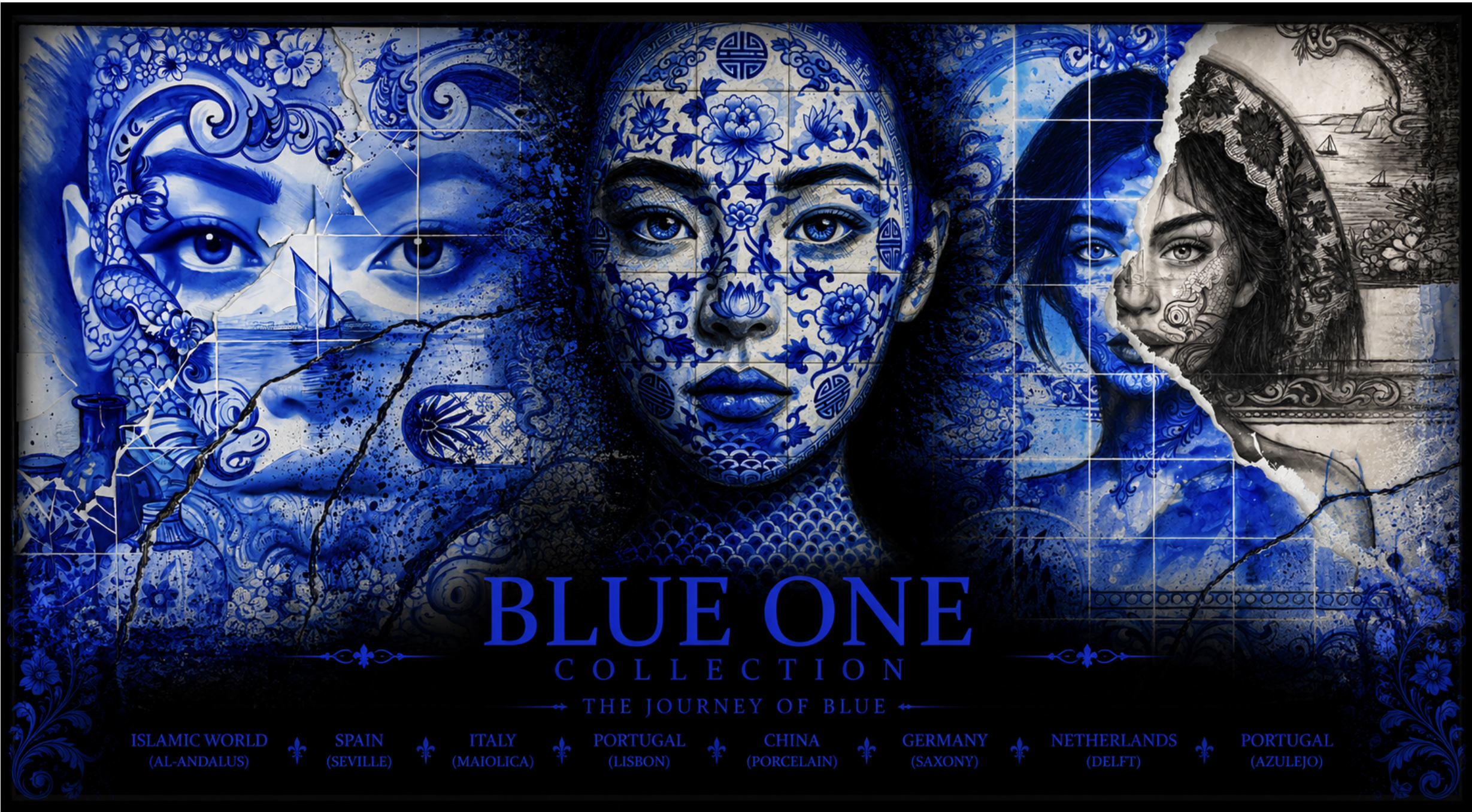
AZULEJO – An Encounter That Begins in Arab Hands
O Gringo Blue One Collection
The word “azulejo” comes from the Arabic az-zulaich, and the glazing technique that makes it possible reached the Iberian Peninsula with the Arabs, between the 9th and 15th centuries. It was this Islamic heritage, filtered through Seville in the late 15th century, that brought to Portugal the first “Hispano-Moorish” tiles — pieces that lined, among others, the halls of the Sintra National Palace, even before a Portuguese production of its own existed.
Shortly after, an Italian artist, Francisco Niculoso Pisano, settled in Seville, introduced to the Peninsula the technique of maiolica — painting directly onto the already-glazed surface, rather than painting the piece after firing. It is this innovation that transforms the azulejo from a decorative surface into a pictorial one. Only from 1560 onward did Lisbon come to have its own pottery workshops, ending seventy years of total dependence on Spanish imports.
The Artisans of Jingdezhen and the Portuguese Commissions
In the early 16th century, Portugal became the first European country to establish direct trade with China, and the maritime route opened something rarer than mere importation: the possibility of commissioning.
The Portuguese began sending to the artisans of Jingdezhen , China’s “porcelain capital,” a production centre with generations of accumulated craftsmanship their own designs and symbols: ships, crosses, family coats of arms, armillary spheres.
Chinese potters then learned to faithfully reproduce an iconography that was culturally foreign to them, creating hybrid pieces now recognised as one of the earliest examples, in the history of luxury, of transcontinental product customisation.
The Museu do Caramulo holds precious testimony to this process: a plate bearing the coat of arms of the Almeida or Mello families, dated to the late 17th century and considered one of the earliest examples of what became known as kraak porcelain , suggesting that it was the Portuguese, not the Dutch, who first commissioned this style, decades before the Dutch East India Company took control of the trade from 1605 onward.
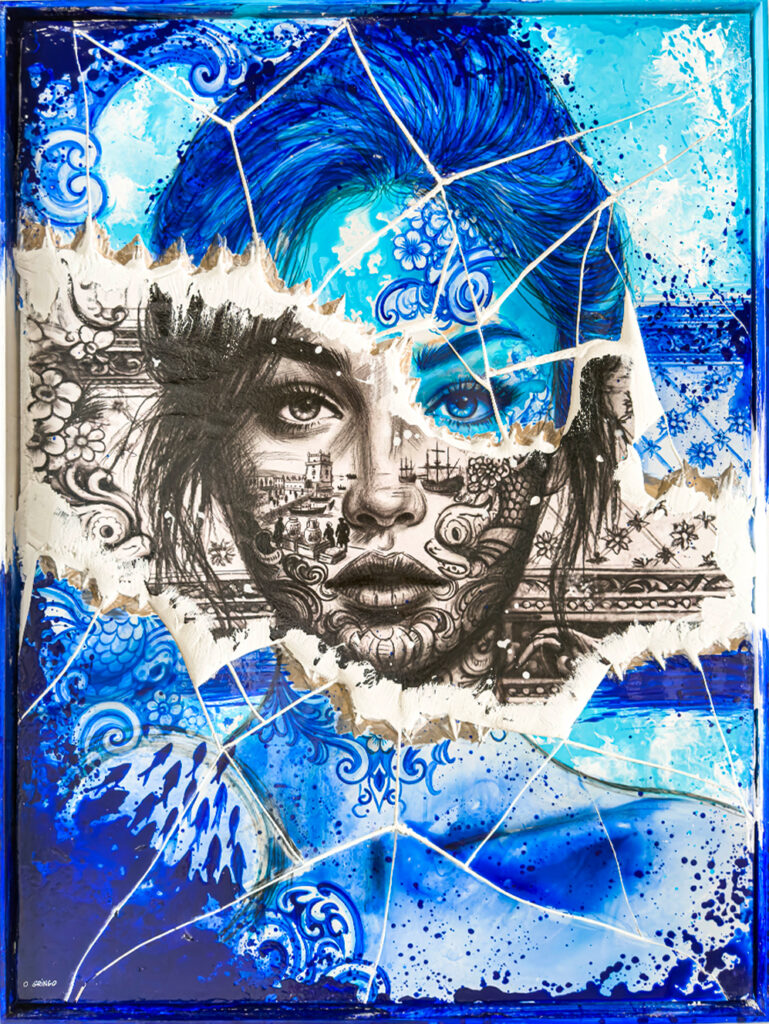
O Gringo – Blue One collection
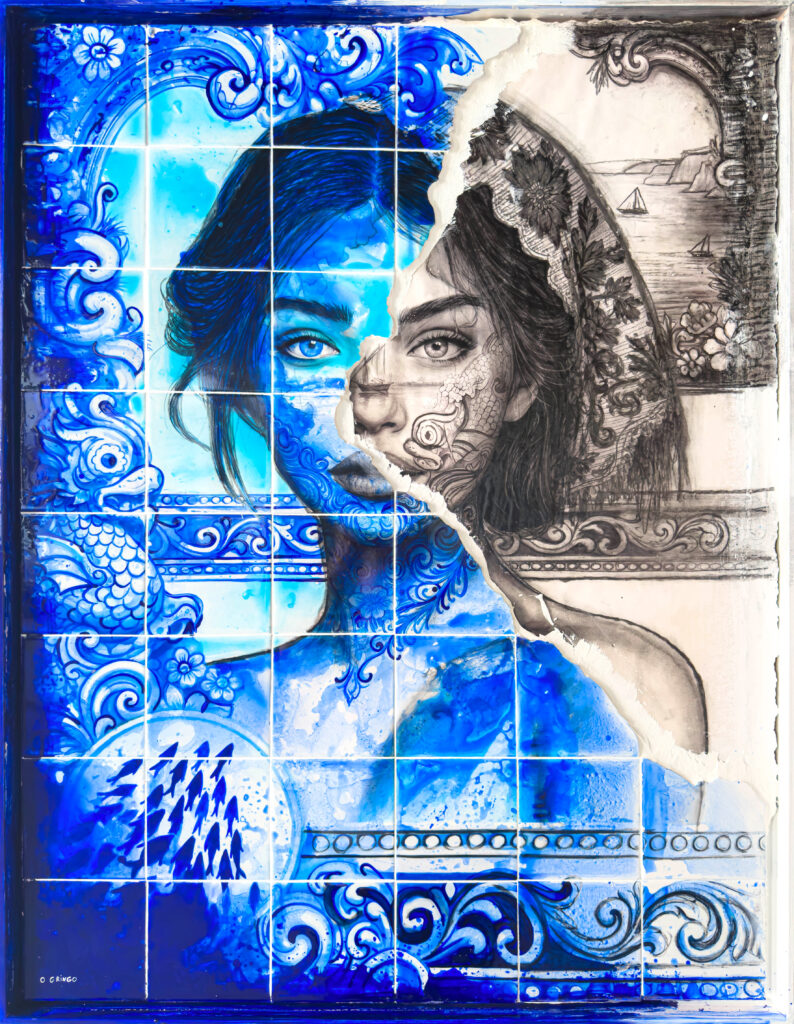
O Gringo – Blue One collection
The Hidden Protagonist: Why Germany Matters in This Story
There is a fact rarely mentioned in narratives about blue azulejo, and it changes how we understand it: none of these traditions ( Portuguese, Dutch, Italian or Spanish ) , would have existed without a raw material that none of them produced.
The cobalt oxide that colours European blue came, almost entirely, from the Erzgebirge mining region in Saxony ,today on the border between Germany and the Czech Republic. Extracted from ores such as skutterudite, safflorite and cobaltite, between the 16th century and the second half of the 18th.
This is not a hypothesis: it is the conclusion of a scientific study published in 2023 in the journal Conservar Património(Figueiredo, Esteves, Pais, Vilarigues & Coentro), co-authored by a researcher from the National Tile Museum itself.
In other words: the same Saxon cobalt that colours the azulejo of Portugal’s Cycle of the Masters is also found in Italian maiolica, Talavera faience, and Delftware. The colour, in the end, has a single mineral origin , even when the designs it paints tell different national stories.
Imitation Becomes Tradition: The Netherlands, Italy and Spain
The Chinese aesthetic model spread across Europe through distinct but converging routes. In the Netherlands, fascination with Chinese blue-and-white porcelain fuelled decades of VOC imports until, in 1647, the Ming-Qing civil war disrupted that trade, forcing Delft’s potters to move from partial imitators to full copyists of the Chinese pattern.
This is how the Delftware we now recognise as deeply “Dutch” was born — despite originating, in fact, as a response to a Chinese absence.
In Italy, it was the maiolica of Savona, by the late 17th century, that fully adopted the blue-and-white vocabulary, documented in the tradition known as Bianco Blu. And in Spain, the “chinesca” series of Talavera de la Reina (produced between the 17th and 18th centuries ) , directly imitate Ming models.
There is a particularly interesting historiographical detail here: for decades it was assumed this influence arrived via Holland, until, in 1975, Spanish researcher Natacha Seseña proposed an alternative thesis , that the Chinese model may have reached Talavera through Portuguese mediation, rather than directly from China or the Netherlands.
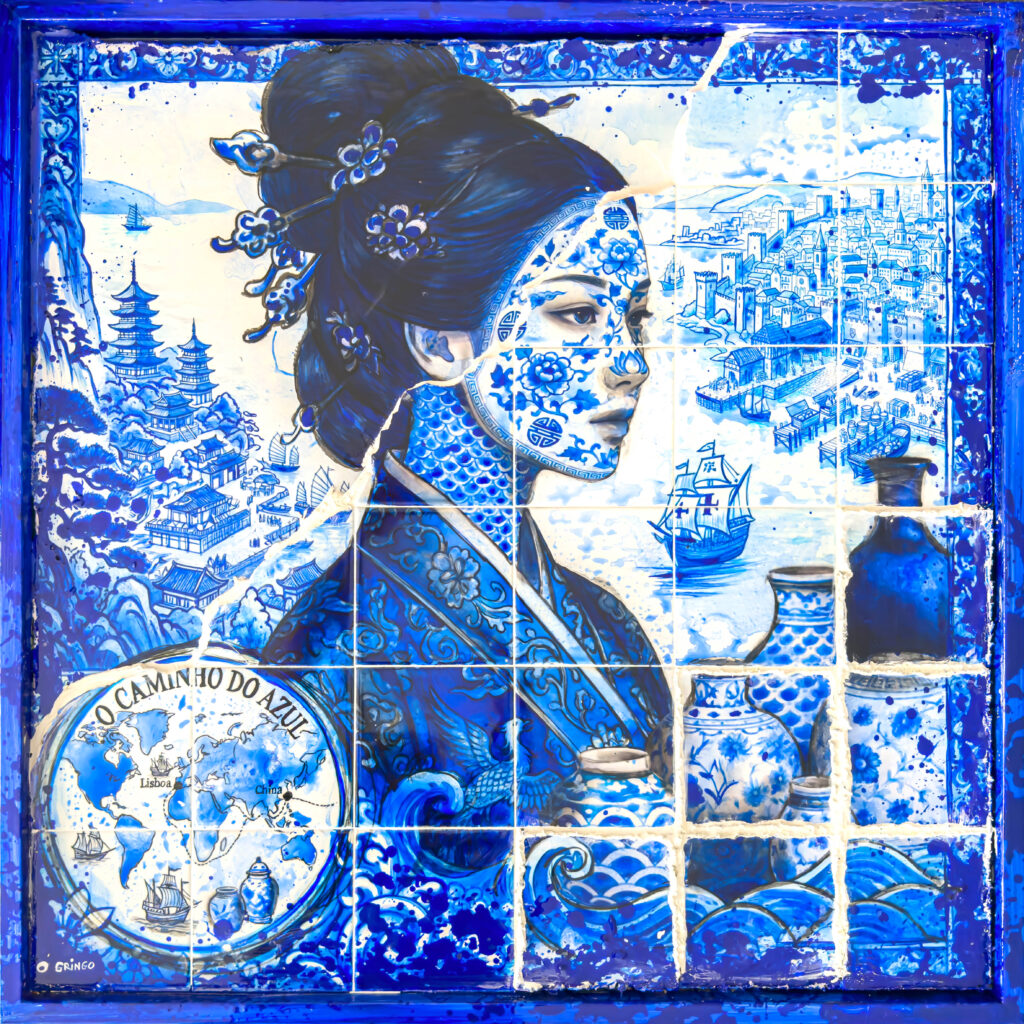
O Gringo – Blue One Collection 2026
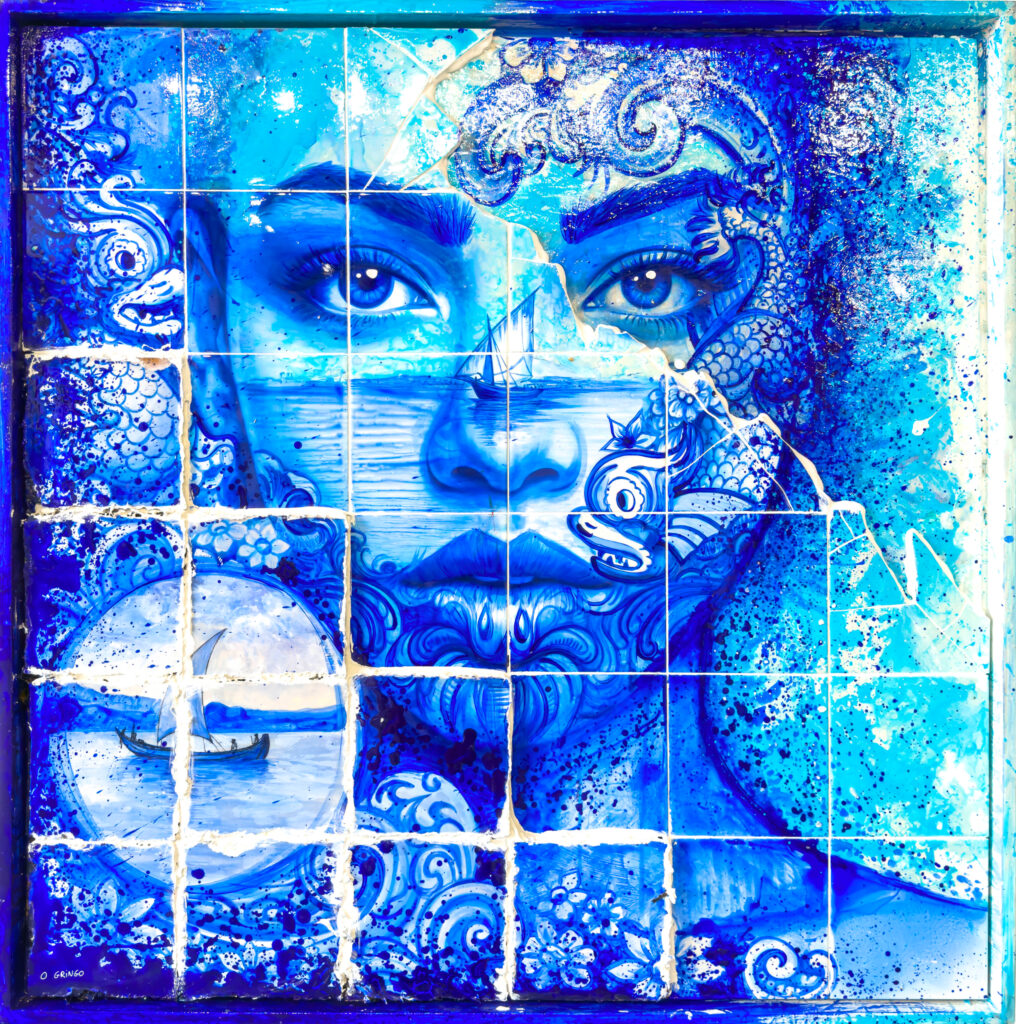
O Gringo – Blue One Collection 2026
THE JOURNEY OF BLUE — AN ARTISTIC CHRONOLOGY
| PERIOD | COUNTRY / REGION / ARTIST | ROLE IN THE JOURNEY |
|---|---|---|
| 9TH–15TH CENTURIES | ISLAMIC WORLD (Al-Andalus) | Islamic ceramic traditions bring glazed tile decoration and geometric ornamental languages to the Iberian Peninsula. The word azulejo itself has Arabic origins. |
| LATE 15TH CENTURY | SPAIN (Seville) | Hispano-Moorish tiles produced in Spain reach Portugal. Spanish workshops supply azulejos used in important buildings, including the royal palaces of Sintra. |
| LATE 15TH–EARLY 16TH CENTURY | ITALY → SPAIN | Italian artist Francisco Niculoso Pisano brings the maiolica technique to Seville, contributing to the transformation of the ceramic surface into an increasingly pictorial medium. |
| EARLY 16TH CENTURY | PORTUGAL → CHINA | Portuguese maritime exchanges with China open a major route for the circulation of ceramics, images and decorative languages between Asia and Europe. |
| c. 1520–1540 | CHINA → PORTUGAL | Chinese workshops produce porcelain for Portuguese patrons, incorporating European symbols such as coats of arms, crosses and armillary spheres into Chinese ceramic production. |
| FROM THE 1560s | PORTUGAL (Lisbon) | Local production of majolica azulejos develops in Lisbon, allowing Portugal to transform techniques and visual languages previously imported from other European ceramic centres. |
| 16TH–18TH CENTURIES | GERMANY (Saxony / Erzgebirge) | The Erzgebirge mining region becomes a major European source of cobalt used to produce blue pigments. Geology and mining therefore become essential elements in the history of European blue ceramic art. |
| LATE 16TH CENTURY | CHINA → EUROPE | Chinese blue-and-white export porcelain, including kraak porcelain, spreads throughout Europe and profoundly influences European decorative taste. |
| 17TH CENTURY | THE NETHERLANDS (Delft) | Inspired by Chinese blue-and-white porcelain, Dutch workshops develop Delftware and transform the Chinese visual model into a distinctive European ceramic language. |
| LATE 17TH CENTURY | ITALY (Savona) | Italian maiolica develops its own blue-and-white vocabulary, including the tradition associated with Bianco Blu. |
| 17TH–18TH CENTURIES | SPAIN (Talavera de la Reina / Puente del Arzobispo) | Spanish ceramic centres develop orientalising and so-called “Chinese” decorative series, creating another interpretation of the blue-and-white language circulating across Europe. |
| AFTER 1755 | PORTUGAL (Lisbon) | Following the Lisbon earthquake and the reconstruction of the city, patterned azulejos become increasingly widespread in architectural and urban environments, contributing to their broader popularisation. |
| 2023 — 21ST CENTURY | O GRINGO | Artist O Gringo brings this centuries-long journey into his own contemporary artistic language. In 2023, his work was presented in a solo exhibition at the National Tile Museum in Lisbon. |
NO SINGLE COUNTRY CREATED THIS STORY. CIVILIZATIONS CREATED IT TOGETHER. Blue was never the colour of one country. It was the result of a journey.
A Collection That Belongs to No Single Country
It is this research , seven peoples, ten centuries, a single mineral pigment … that underpins the Blue One Collection. Islamic ornament, Spanish ceramics, Italian maiolica, Chinese porcelain, German cobalt, Dutch earthenware … into a mixed-media language of his own, crossing stone, ceramic, azulejo, fine art paper, wood and resin.
The works resulting from this research can be seen on the official Blue One Collection page.
You should read it too :
O Gringo National Tile Museum
O Gringo and CERCIMA: When Art Builds a Better Future
A Contemporary Artwork Connecting France, Portugal and the United States
O Gringo Estrela da Amadora: Sonhadores, o mural em azulejo pela inclusão
Main sources: Figueiredo, E.; Esteves, L.; Pais, A. N.; Vilarigues, M.; Coentro, S. (2023). “As cores na azulejaria portuguesa: uma revisão.” Conservar Património, 42, pp. 72-80. DOI: 10.14568/cp27252. · Mimoso, J. M. (2015), LNEC. · National Tile Museum, Lisbon. · Museu do Caramulo. · Seseña, Natacha (1975), La cerámica popular en Castilla la Nueva, Madrid: Editora Nacional.