Discover the art collections of O Gringo, a contemporary artist who structures his work through distinct thematic series shaped by historical moments, personal experiences, journeys and people encountered throughout his life. Each collection becomes a visual chapter, connected to memory, emotion, colour, form and material experimentation. Rather than remaining fixed in time, these series are often revisited, reinterpreted and brought into new technical phases, allowing earlier ideas to return through different materials, processes and discoveries within the artist’s evolving imagination. Working across hybrid mixed media, ceramics, Fine Art paper, wood, canvas, marble, resin, photography and other unexpected materials, O Gringo transforms each collection into an open territory where past experiences continually generate new contemporary expressions.
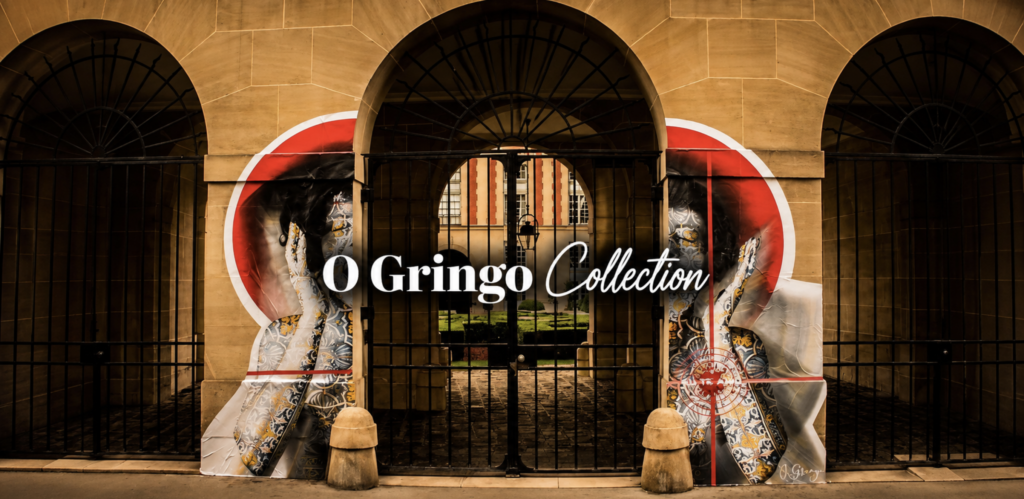
O GRINGO Official Archive
O Gringo | Place des Vosges, Paris (2018)
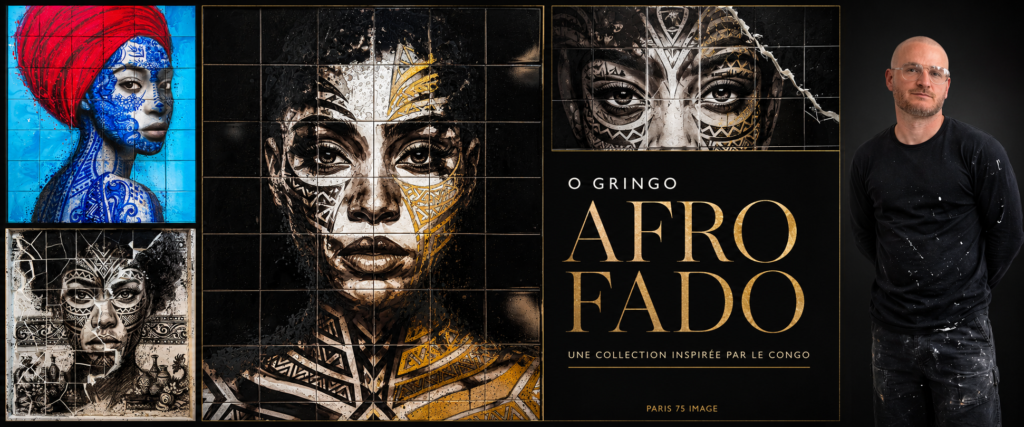
O Gringo – Afro Fado Collections – created the Afro Fado Collection following his professional journeys to the Republic of the Congo.
The collection connects African identity, Atlantic memory, rhythm and saudade with contemporary art.
The Route of Blue — How German Cobalt and Chinese Porcelain Shaped European Azulejo. Before it was a collection, “The Journey of Blue” was a research question …
O Gringo – The Collection Method
I always like to explain how an artist should work in order to best reveal their creativity, versatility and discipline. And the example I use is always the same: to follow those I believe to be the greatest artists of all time in this field , the designers and artistic directors of the great fashion maisons.
Let us imagine that, each year, at minimum, they must present two collections, one of which must be completely different from the previous one, yet without ever losing the artistic line and style that define the brand. That is the formula for an artist to remain constantly in research, turning that process into an opportunity to offer new perspectives to their regular collectors while, at the same time, winning over new audiences not yet seduced by their work.
There should be no fear of getting it wrong, for risk always leads to new discoveries, and constant research thematic, technical and historical , leads to other worlds not yet explored.
I like to stress that the work in music, in fashion and in art is exactly the same. Consistency, hard work, discipline, purpose and cold blood , because an artist will never please everyone, but what matters is that they find people who identify with them, who have a sensibility connected to their work. As in music, that number of people grows over time: they identify, they collect, they consume, and they wait for what comes next.
We can also look to the example of authors, of writers. In the world of publishing, a writer may find no success or recognition with their first or second book , until the third one breaks through, and everyone who has since consumed their work turns back to seek out the earlier ones, which had gone unnoticed.
To maintain consistency in the development of collections is nothing more than giving oneself , and giving others too the opportunity to discover you.
This is only my opinion, and my own way of working.
Gusttavo Henri Borges
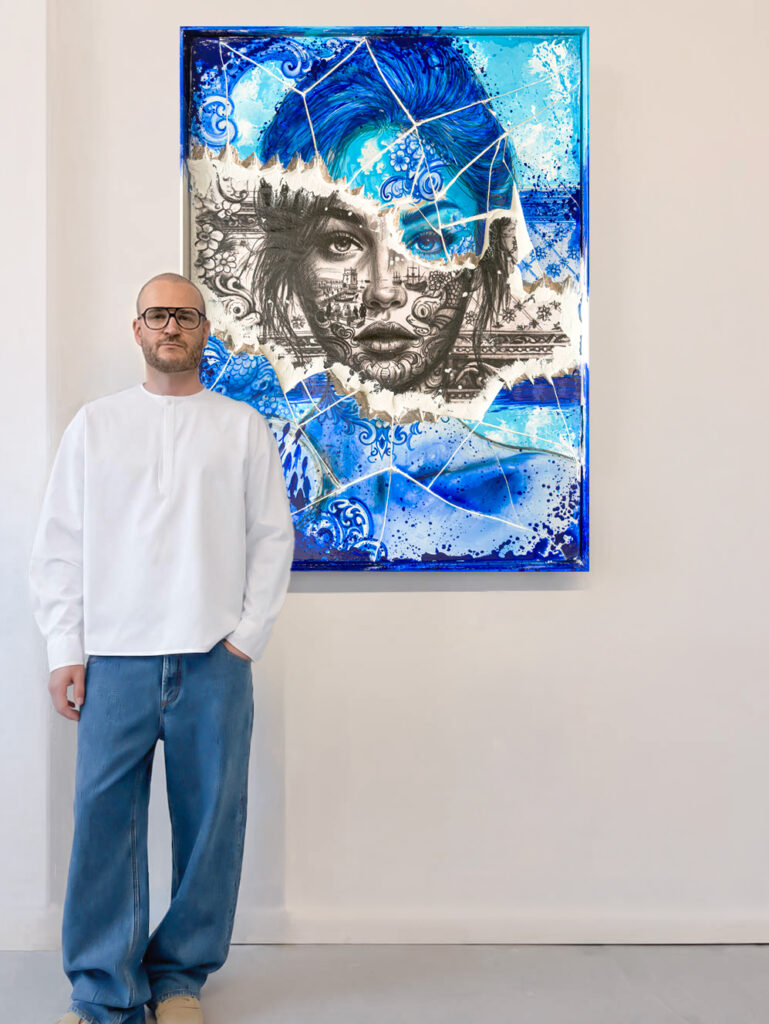
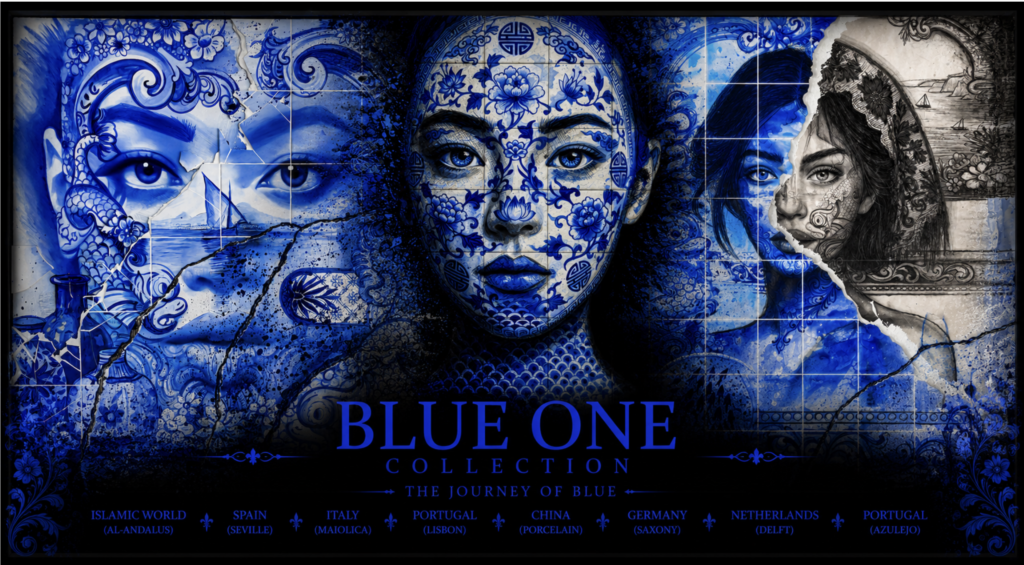
O Gringo – Blue One Collections – 2026
The Journey of Blue — When the Azulejo Crossed Continents
The photograph above belongs to the Blue One Collection, born from the encounter between stone and the delicacy of fine art paper. “The Journey of Blue” emerges from a fifteen-year artistic investigation conducted by O Gringo into the history of the azulejo, left in Europe by the Arabs and carried forward, in that order, through the centuries, by the Spanish, the Italians, the Portuguese, the Dutch and the Germans, the Portuguese maritime routes, and the cultural exchanges that shaped the visual identity of Europe.
The collection revisits the sixteenth century, when Portugal became the first European country to import Chinese porcelain on a large scale , then known as “white gold” through its maritime routes, commissioning Chinese artisans to create pieces decorated with its own symbols: ships, crosses, coats of arms, armillary spheres.
From this encounter was born a unique visual language, one that would go on to transform Dutch, Italian, Spanish and Portuguese ceramics, replacing older, polychrome palettes with the cobalt blue on white ground inspired by Ming porcelain:
in Portugal, azulejo-making absorbed the model through kraak porcelain, commissioned by the Portuguese themselves as early as the sixteenth century; in the Netherlands, Delft came into its own after 1647, when civil war in China disrupted imports and Dutch potters began fully imitating the Chinese pattern; in Italy, the maiolica of Savona adopted the same blue-and-white vocabulary from the late seventeenth century onward; and in Spain, the “chinesca” series of Talavera de la Reina and Puente del Arzobispo, produced between the seventeenth and eighteenth centuries, directly imitated Ming porcelain , with scholar Natacha Seseña proposing, in 1975, that this influence reached Talavera not directly from China, but through Portuguese mediation.
Through a contemporary reading of this shared heritage, O Gringo brings together visual elements from China, Portugal and Europe in a narrative that celebrates the dialogue between civilisations and the power of culture as a bridge between peoples.