Introduction – O Gringo at the National Tile Museum
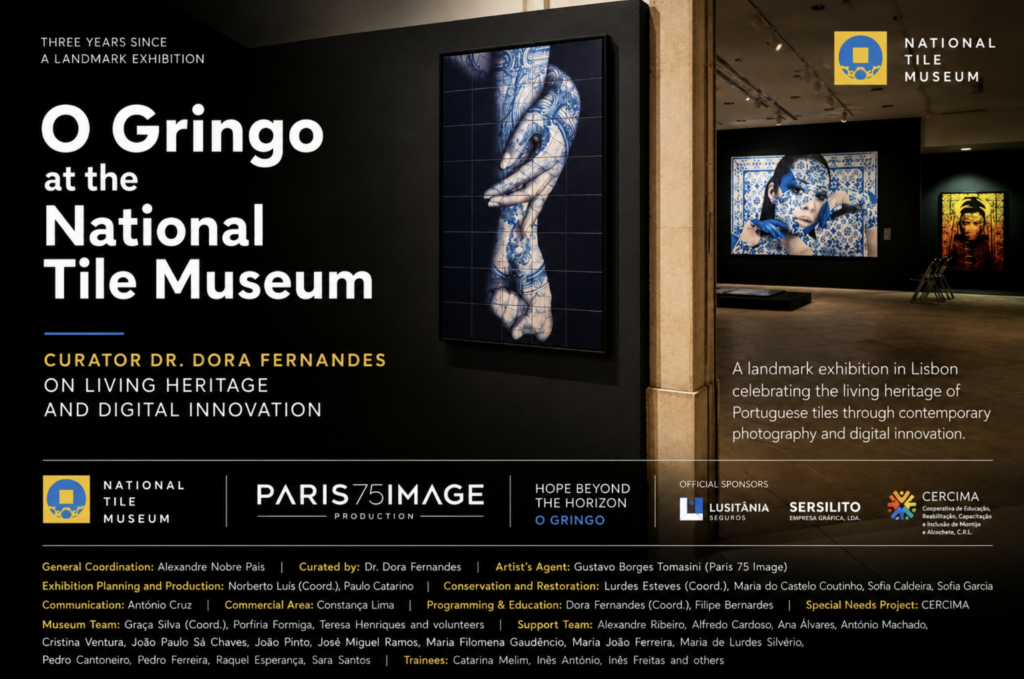
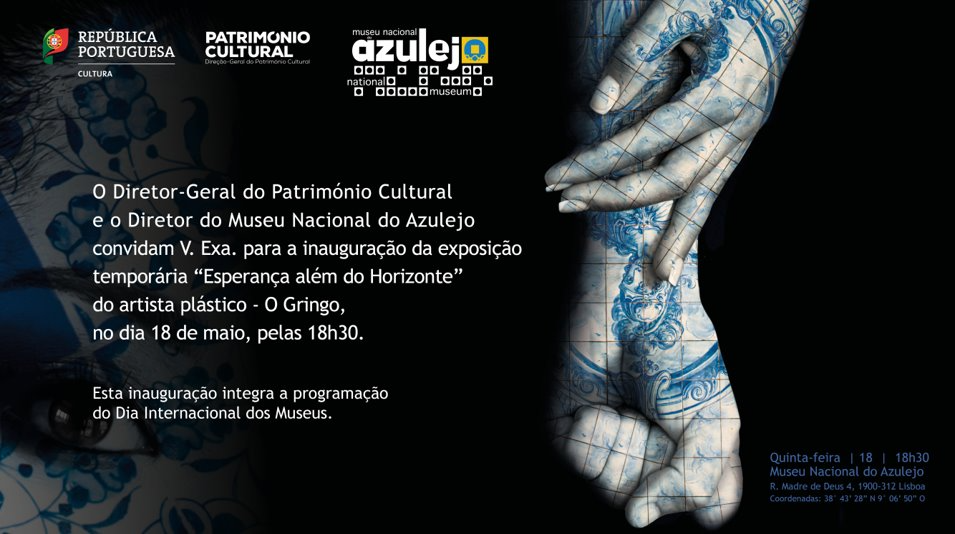
Some moments in an artist’s career become defining milestones, not because of the publicity they generate, but because of the institutions that choose to embrace them. In June 2022, at the invitation of Dr. Alexandre Pais—then Director of the National Tile Museum (Museu Nacional do Azulejo) and today President of the Board of Museums and Monuments of Portugal (Museus e Monumentos de Portugal, E.P.E.)—French artist O Gringo, the artistic name of Bastien Tomasini, inaugurated the solo exhibition Hope Beyond the Horizon (Esperança Além do Horizonte) in the museum’s main entrance gallery.
The exhibition was curated by Dr. Dora Fernandes, Head of the Museum’s Education Department and one of Portugal’s leading specialists in the interpretation and dissemination of Portuguese tile heritage.
Originally scheduled to remain on display for approximately four months, the exhibition was extended by the museum and remained open to the public for around six months, concluding with a closing concert by renowned Portuguese Fado singer Kátia Guerreiro, whose participation also formed part of the artistic narrative of the project.
Three years after its opening, Hope Beyond the Horizon continues to stand as one of the most significant institutional recognitions in O Gringo’s career and as an important example of how contemporary artistic creation can engage with one of Portugal’s most emblematic cultural traditions.
Rather than presenting contemporary art as an isolated intervention within a historical museum, the exhibition proposed a dialogue between five centuries of Portuguese tile-making tradition and a new visual language built through photography, digital technology and ceramic production. At the centre of this dialogue stood the curatorial vision of Dora Fernandes, whose interpretation positioned the project not as a rupture with tradition, but as part of the continuous evolution of Portuguese azulejo.
This article revisits Hope Beyond the Horizon through the words and writings of its curator, drawing primarily upon the official exhibition catalogue published by the National Tile Museum in 2023, together with institutional documentation and public statements made during the exhibition.
Three years later, Dora Fernandes’ reflections continue to offer valuable insight into the museum’s understanding of Portuguese tile art—not simply as an object of historical preservation, but as a living artistic language capable of continuously reinventing itself while remaining faithful to its cultural identity.
A Landmark Exhibition at Portugal’s National Tile Museum
In June 2022, the National Tile Museum in Lisbon opened Hope Beyond the Horizon, the first major museum exhibition dedicated to the French artist O Gringo. Conceived under the curatorial guidance of Dr. Dora Fernandes, Head of the Museum’s Education Service, the exhibition proposed a dialogue between Portugal’s centuries-old ceramic heritage and a contemporary artistic language rooted in urban art, symbolism, and social reflection.
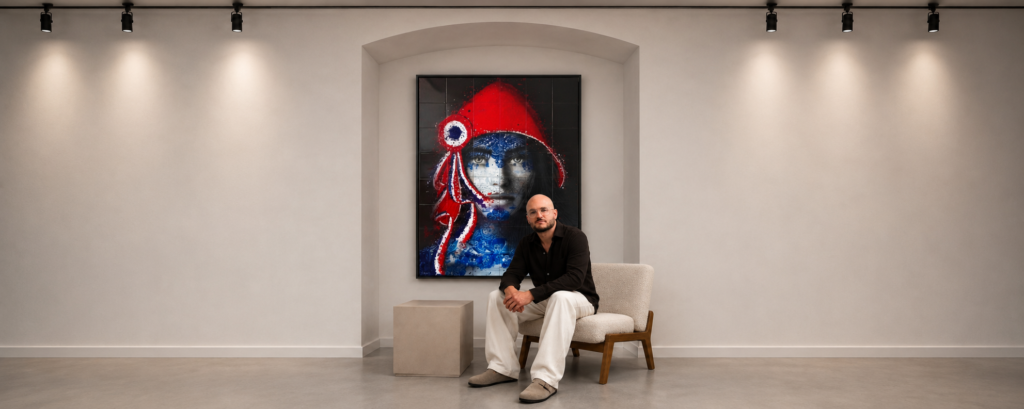
Rather than presenting the works as isolated paintings, the exhibition explored the concept of Living Heritage, demonstrating how traditional cultural expressions can evolve through contemporary artistic practice. O Gringo’s reinterpretation of the Marianne—a universal symbol of liberty and republican values—became the central element of this dialogue, connecting French iconography with Portugal’s long tradition of storytelling through ceramic tiles.
Initially scheduled to remain on view for approximately four months, the exhibition attracted sustained public interest and was extended by the Museum, remaining open for nearly six months. This exceptional duration reflected both the institutional relevance of the project and the public’s engagement with its educational and cultural dimensions.
Three years after its inauguration, Hope Beyond the Horizon continues to be regarded as one of the most significant contemporary exhibitions presented by the National Tile Museum, illustrating how historical heritage and contemporary artistic creation can coexist to inspire new interpretations of cultural identity.
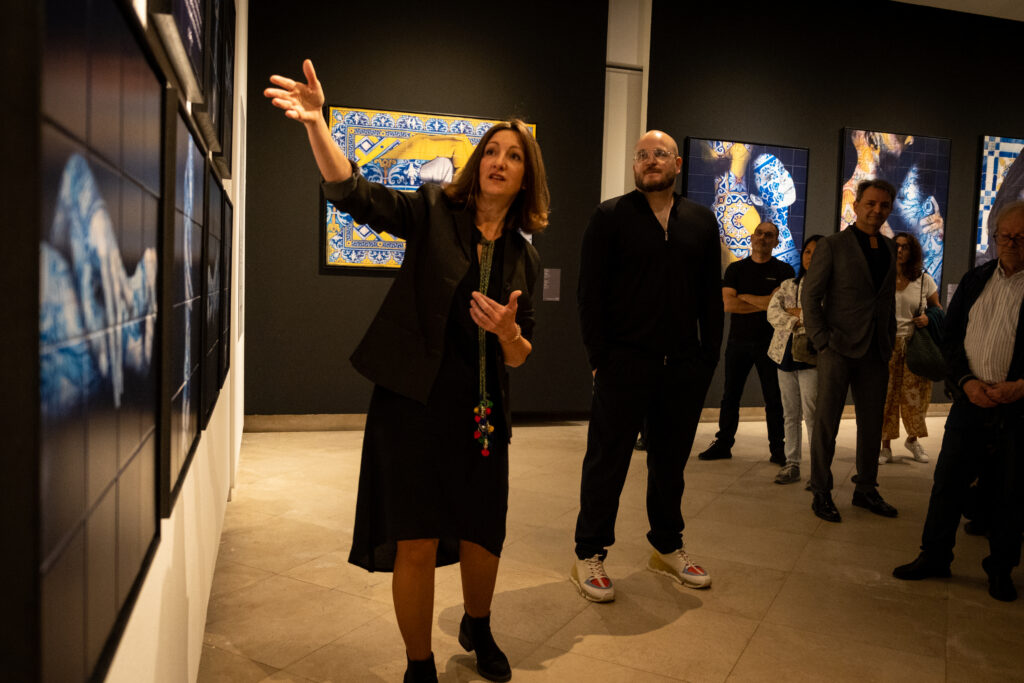
DR. Dora Fernandes and O Gringo
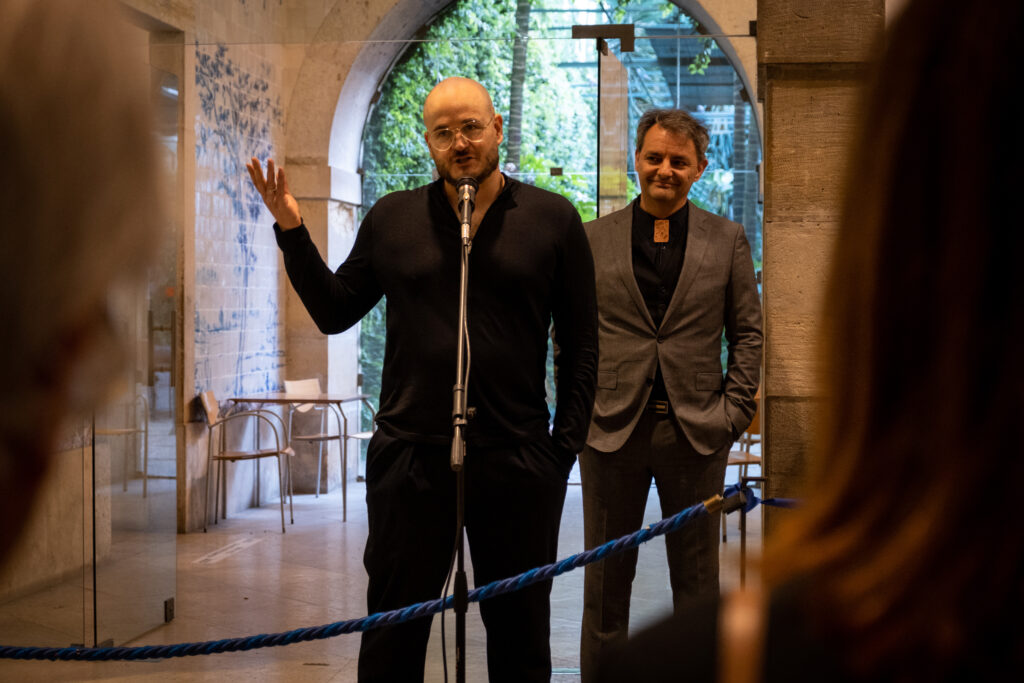
O Gringo and DR. Alexandre Pais
Living Art: Dr. Dora Fernandes’ Curatorial Vision
The exhibition was built around the concept of Living Art, a curatorial approach developed by Dr. Dora Fernandes that encourages museums to engage with contemporary artistic creation while remaining rooted in historical heritage. Rather than treating the museum as a repository of the past, this vision positions it as a dynamic cultural space where tradition and innovation coexist.
Within this framework, O Gringo’s work was not presented as a break from history, but as a continuation of an artistic dialogue spanning centuries. His paintings, inspired by the symbolic figure of Marianne, introduced themes of freedom, identity, hope and civic responsibility into a museum internationally recognized for preserving one of Portugal’s most important collections of ceramic art.
According to Dr. Dora Fernandes, contemporary art has the capacity to reactivate historical memory by creating new interpretations that speak to present-day audiences. Hope Beyond the Horizon embodied this philosophy, demonstrating how artistic heritage remains alive when museums invite contemporary creators to contribute new perspectives without losing sight of historical continuity.
The exhibition therefore became more than an artistic presentation; it represented a meeting point between education, cultural heritage and contemporary visual language, reinforcing the National Tile Museum’s role as an institution committed to preserving history while encouraging artistic innovation.
La Marianne Reimagined: A Contemporary Symbol of Freedom
At the heart of Hope Beyond the Horizon stands La Marianne, the emblematic figure of the French Republic. For more than two centuries, Marianne has represented the universal values of liberty, equality and civic responsibility. Through O Gringo’s artistic vision, this historic symbol was reinterpreted for the twenty-first century without losing its original meaning.
Rather than reproducing the classical representation of Marianne, O Gringo transformed her into a contemporary visual language inspired by urban culture, vibrant color, expressive typography and symbolic composition. His works invite viewers to reflect on freedom not as a historical achievement alone, but as a living value that must be continuously protected and reimagined by every generation.
This reinterpretation created a compelling dialogue with the National Tile Museum itself. Just as Portuguese azulejos have narrated stories of faith, society and national identity for centuries, O Gringo’s paintings use contemporary visual expression to tell new stories about democracy, cultural identity and hope. The exhibition therefore established a bridge between historical narrative and modern artistic communication.
Far beyond its French origins, Marianne emerged throughout the exhibition as a universal symbol capable of transcending borders. Visitors encountered an artistic language that connected European cultural heritage with contemporary global issues, demonstrating that the ideals represented by Marianne remain relevant in an increasingly interconnected world.
Through this renewed iconography, Hope Beyond the Horizon affirmed that art possesses the unique ability to preserve historical memory while simultaneously creating new narratives for future generations.
Azulejos Through Contemporary Art
One of the most distinctive aspects of Hope Beyond the Horizon was O Gringo’s innovative reinterpretation of the azulejo. Rather than reproducing traditional ceramic decoration, the artist transformed the tile into a contemporary artistic medium, combining photography, digital composition, mixed media techniques and handcrafted finishes.
The creative process began with extensive historical research inside the National Tile Museum. O Gringo photographed original decorative patterns, ornamental motifs and historic tile compositions before integrating them into his own visual language. These centuries-old designs were digitally reimagined and merged with carefully staged photographic portraits, creating works that respected the heritage of Portuguese ceramics while introducing a completely contemporary aesthetic.
Printed in high definition on Portuguese ceramic tiles, many of the works were further enhanced by hand using charcoal, spray paint and transparent protective finishes. This combination of digital precision and manual intervention created unique surfaces that blurred the boundaries between photography, painting, sculpture and ceramic art.
The exhibition demonstrated that innovation does not require abandoning tradition. Instead, it showed how historical craftsmanship can inspire new artistic practices capable of engaging contemporary audiences while preserving the cultural significance of Portugal’s most iconic artistic expression.
By introducing digital technologies into the language of azulejos, O Gringo contributed to an ongoing dialogue about the future of cultural heritage, illustrating how museums can become places where history continues to evolve through artistic experimentation rather than remaining confined to the past.
CHECK HERE
A Museum Exhibition with Lasting Institutional Impact
Hope Beyond the Horizon extended far beyond the walls of the National Tile Museum. By bringing together contemporary artistic practice, cultural heritage and educational engagement, the exhibition became a reference point for discussions about the evolving role of museums in the twenty-first century.
Throughout its presentation, the project attracted the attention of cultural professionals, educators, students and institutional representatives interested in the dialogue between historical collections and contemporary artistic expression. Its interdisciplinary approach demonstrated how museums can foster meaningful conversations between art, history, technology and civic values.
The exhibition also strengthened collaborations between cultural institutions and the academic community. Universities, schools and educational organizations found in Hope Beyond the Horizon an example of how contemporary art can enrich historical interpretation while encouraging critical thinking about identity, democracy and cultural heritage.
More importantly, the project reaffirmed that museums are not only places of preservation but also spaces of creation, research and public engagement. By welcoming an artist whose work bridges photography, urban art, digital media and traditional craftsmanship, the National Tile Museum demonstrated its commitment to supporting innovative cultural initiatives grounded in historical respect.
Three years after its inauguration, Hope Beyond the Horizon continues to illustrate how a museum exhibition can generate lasting cultural value, inspiring new audiences while reinforcing the importance of preserving heritage through contemporary artistic dialogue.
DR. Dora Fernandes in ART PLUS 75 : https://www.instagram.com/artplus75/
A Defining Moment in O Gringo’s International Career
Hope Beyond the Horizon marked a significant milestone in O Gringo’s artistic journey. Presented by one of Portugal’s leading national museums, the exhibition confirmed the artist’s ability to build meaningful connections between contemporary creation, historical heritage and international cultural dialogue.
Rather than representing the culmination of a career, the exhibition became the foundation for a series of new institutional collaborations and international projects. Its success reinforced O Gringo’s commitment to developing artworks that combine artistic innovation with cultural diplomacy, creating visual narratives capable of crossing geographical, linguistic and political boundaries.
The themes explored during the exhibition—freedom, identity, hope and shared cultural memory—continue to influence the artist’s work today. Marianne remains at the center of this evolving artistic research, serving not only as a symbol of the French Republic but also as a universal representation of democratic values, resilience and human dignity.
As O Gringo’s work reaches new audiences through museums, galleries, universities and international institutions, Hope Beyond the Horizon continues to stand as one of the defining chapters of his career. The exhibition demonstrated that contemporary art can successfully engage with historical collections while contributing to broader conversations about culture, education and international cooperation.
Three years after its opening, the project remains an enduring example of how artistic vision, institutional collaboration and cultural heritage can come together to create an exhibition whose significance extends well beyond its original presentation.
Legacy: Why Hope Beyond the Horizon Still Matters Today
Three years after its inauguration, Hope Beyond the Horizon continues to resonate as more than a museum exhibition. It remains a powerful example of how contemporary art can engage with historical heritage, foster cultural dialogue and inspire new ways of interpreting the past through the lens of the present.
By bringing O Gringo’s contemporary vision into one of Portugal’s most important cultural institutions, the National Tile Museum demonstrated that heritage is not static. It evolves through research, artistic experimentation and meaningful encounters between history and modern creativity. The exhibition affirmed that museums can preserve tradition while embracing innovation, creating experiences that speak to both national identity and universal human values.
The project also highlighted the enduring relevance of Marianne as a symbol that transcends borders. Reimagined through O Gringo’s artistic language, she became a bridge between French republican ideals and Portugal’s rich artistic heritage, reminding audiences that freedom, hope and cultural exchange remain essential foundations of democratic societies.
Today, Hope Beyond the Horizon continues to inspire scholars, museum professionals, artists and visitors interested in the relationship between cultural heritage and contemporary artistic practice. Its legacy extends beyond the galleries of the National Tile Museum, contributing to ongoing conversations about education, cultural diplomacy and the transformative power of art.
As museums around the world seek new ways to connect historical collections with contemporary audiences, Hope Beyond the Horizon stands as a lasting testament to the value of artistic innovation grounded in respect for history. It remains an enduring chapter in O Gringo’s career and an important contribution to the dialogue between tradition and contemporary creation.

Author
Gusttavo Henri Borges Tomasini
Founder & CEO — Paris 75 Image
Cultural Producer • Art Director • International Art Consultant
Lisbon • Paris
See Also
-
O Gringo at the National Tile Museum: Curator Dora Fernandes on Living Heritage and Digital Innovation
Introduction – O Gringo at the National Tile Museum Some moments in an artist’s career become defining milestones, not because of the publicity they generate, but because of the institutions that choose to embrace them. In June 2022, at the invitation of Dr. Alexandre Pais—then Director of the National Tile Museum (Museu Nacional do Azulejo)…